
Fourteen years at a mixed-species clinic in Colorado Springs has taught me one thing about first-time pet owners: they don't call the vet because they don't know when to call the vet. Most of the panicked 3 a.m. calls I take are about things I could have talked you through in four minutes — and most of the genuinely serious problems walk in late because nobody warned anyone what the real red flags look like. That gap is why I started writing this blog. My job at the front desk isn't just to treat animals; it's to give you a clear answer to the question every new owner asks me in the exam room, usually with trembling hands: "Is this something I should worry about?"
I'm Willa Sutter, DVM. I've spent nearly a decade and a half treating dogs, cats, and the occasional very opinionated guinea pig in a busy general practice. At home I have my own small zoo — Biscuit and Copper (dogs), Mabel and Oscar (cats), and Peanut, a senior guinea pig who runs the household and outranks everyone including my husband Adam. My kids, Ruby and Otis, have grown up learning the same things I teach my clients: animals can't tell you what hurts, so it's your job to learn how they tell you anyway.
This blog is my answer to the same conversation I've had a thousand times. It's practical, it's honest about money, and it will never shame you for calling about something small. Because in my line of work, I've learned that a good start beats a late fix.
When to Call the Vet: The Simple Rule That Ends 80% of My After-Hours Calls
Here's the rule I give every new owner, and it's short enough to tape to your fridge: call if something changes suddenly, call if something hurts, call if your pet can't keep food or water down, call if breathing looks hard, and call if your gut says something is wrong. Most of the time, the call ends with "keep an eye on it and let me know by morning." But that phone call turns a question into a plan, and a plan kills the panic that keeps people awake at 3 a.m. scrolling forums.
The Difference Between "Watch It" and "Come In Now"
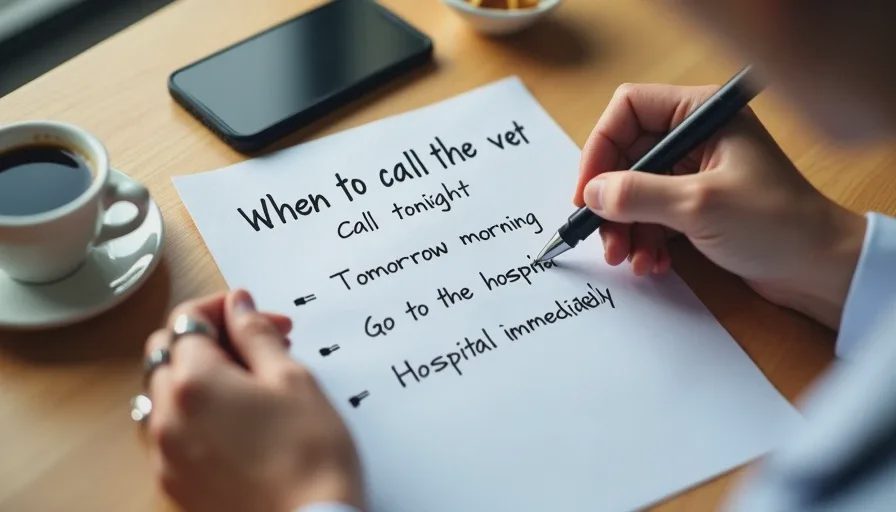
The hardest part of knowing when to call the vet is learning the difference between a nuisance symptom and an emergency. In my practice I divide after-hours questions into three buckets:
Watch and monitor — a single bout of vomiting in an otherwise playful dog, a soft stool, a sneeze. Log it, keep your pet hydrated, and report back if it repeats.
Call in the morning — repeated vomiting, diarrhea that lasts more than a day, appetite that's clearly off, or limping that doesn't improve overnight.
Go now — difficulty breathing, collapse, a bloated or hard belly, an unproductive retch, seizure, or a known toxin exposure (grapes, xylitol, lilies). Don't wait, don't call for a second opinion, don't check one more forum post.
The gray zone is where people get stuck, so here's my blanket permission: when you're genuinely unsure, call. No vet worth their license will be annoyed by a worried first-timer. What we do hate is the call that starts with "I was going to bring him in last week, but he seemed fine until this morning." And that's exactly the sentence I want to spare you from ever saying.
The Four Warning Signs I Wish Every Owner Knew Before They Needed Them
There are four symptoms I see in critical cases that almost every first-time owner mistook for something minor. If you remember nothing else from this blog, remember these:
Not eating for 24 hours. Cats especially will quietly stop eating when they feel sick, and a cat that hasn't eaten in a couple of days can be in real trouble fast. A missed meal isn't panic-worthy, but a second full day of refusing food is a phone call.
Changes in urination. Straining, blood, or a cat in and out of the litter box all day can be an emergency in male cats especially. Never assume it's "just a urinary tract infection" and wait.
Lethargy that isn't just a lazy day. Puppies and kittens crash and play; an adult dog that won't lift its head is not being dramatic. A good rule: if your pet won't take a treat it usually adores, call.
Unusual breathing. Fast, labored, or noisy breathing, gums that are pale or blue, or a belly that moves hard with each breath — this is the one I never want you to wait on.
None of these are scare tactics. I'm telling you because I've watched too many loving families wait a weekend too long out of politeness, fear of a big bill, or just not knowing. And the cost of knowing is one phone call.

Why I'm the One Writing This (and What I Bring to the Table)
People sometimes ask me what makes a general-practice vet qualified to write about first-time pet care, and the honest answer is: I see it every single day. I'm not a specialist in exotic feats of medicine; I'm the vet who sees the new puppy for vaccines on Monday and the senior cat for weight check on Friday. I've taken the calls, I've run the same wellness bloodwork a thousand times, and I've had the same "here's what it really costs" conversation in a thousand exam rooms.
I also live this stuff at home. When we brought home Copper as a puppy, Ruby was eight and Otis was five, and my kitchen whiteboard got a new column: who ate, who pooped, who's sulking. That whiteboard is still there, because tracking your pets' normal habits is genuinely how you catch problems early — and it's a habit I'll teach you here, too. When I introduce a new animal to the house, I narrate it like a nature documentary for my kids' entertainment. And when Peanut, my senior guinea pig, decides she's done with being ignored, the whole family knows it.
My point is simple: I'm not writing from a textbook. I'm writing from fourteen years of exam rooms and one very crowded house in Colorado Springs. Everything I tell you here is something I've either done myself, watched a client do, or wished a client had done sooner.
What This Blog Will (and Won't) Be
This isn't a medical database and it isn't a replacement for your own veterinarian. You need a real relationship with a local vet — that's the single most useful thing you can set up before an emergency ever happens. What this blog gives you is context: normal timelines, honest cost ranges, clear scripts for what to say on the phone, and the confidence to know when to call the vet and when to let a sleeping dog lie.
What I won't do is sell you things you don't need or guilt you into testing I wouldn't run on my own animals. I'll be honest about what things cost, because money stress is a real part of pet ownership and pretending otherwise helps no one. And I'll never talk down to you, because the nervous owner who asks ten questions is my favorite kind of client.
The Promise I Make at the End of Every Exam
Every first visit ends the same way in my exam room. I look at the family — usually one adult clutching a carrier, one kid vibrating with excitement — and I say: "You're going to have questions, and they're going to feel dumb. They're not. Call me." This blog is that same sentence, written down so it's always in your pocket.
Bringing a pet home is one of the happiest, most nerve-wracking things a family can do. You will over-worry, you will misread a symptom, and you will very likely call about something that turns out to be nothing. That's not a failure of yours — it's just what caring looks like when you're new at it. My job is to make sure that when something is actually wrong, you'll recognize it in time.
Because after all these years, I still believe it. A good start beats a late fix.



No comments yet — grab the first one.