
Here's the thing nobody prepares you for: knowing when to call the vet matters most at 11 p.m. on a Sunday, with an animal the size of a loaf of bread, and that's exactly the situation I found myself in with Peanut — my senior guinea pig, the tiny monarch of our household. I'm a vet with fourteen years of experience, and I still almost missed the signs. That night cost me $400 and taught me more about emergency preparedness than any textbook ever did.
The Warning Signs I Almost Missed
Peanut is seven years old, which in guinea pig years is firmly "senior" — most guinea pigs live four to eight years, and Peanut has spent the last two of his ruling us all with quiet dignity. He's got the run of a big enclosure in the kitchen, and his morning routine is predictable: wheek at the fridge, claim his pea flakes, chatter at whoever walks past.
So the night it happened, the first thing I noticed was what I didn't hear. No wheeking. When I looked in, Peanut was hunched in the corner of his house, not curled up in his usual relaxed sprawl. His eyes were half-closed, and when I offered a pea flake — the offering that has never, in seven years, been refused — he didn't move.
Here's the part that haunts me a little: I almost talked myself out of acting. It was late, he was old, maybe he was just having an off day. Animals slow down, right? I rationalized, and I know better. I've given this exact lecture to a hundred owners.
The rules I should have recited to myself — the rules I now hand to everyone:
Guinea pigs are prey animals. They hide illness as a survival instinct, so by the time they look sick, they've often been sick for a while.
If a guinea pig stops eating, that's an emergency, not a mood. Their GI tract depends on constant fiber moving through it.
If you see no droppings for twelve hours, that is a 911-level signal. Not "call tomorrow." Call now.
Hunched posture, grinding teeth, and refusing favorite foods are three red flags that stack up fast.
That list is my "when to call the vet" cheat sheet for small pets, and it's the same one I give every owner of a guinea pig, rabbit, or hamster. Small pets crash fast. Their window between "a bit off" and "critical" is measured in hours, not days.
The Drive to the Emergency Clinic
I got Peanut into a carrier with a soft towel and his favorite hay, and Adam drove while I sat in the back seat talking to him in the low, calm voice I use for frightened animals. Kids were asleep; the emergency clinic is forty minutes away; and in the quiet of that car, I did what I tell every owner to do: I ran through what I knew. When did he last eat? That morning. Last droppings? Early afternoon, if I was honest. That meant the window was open, but barely.
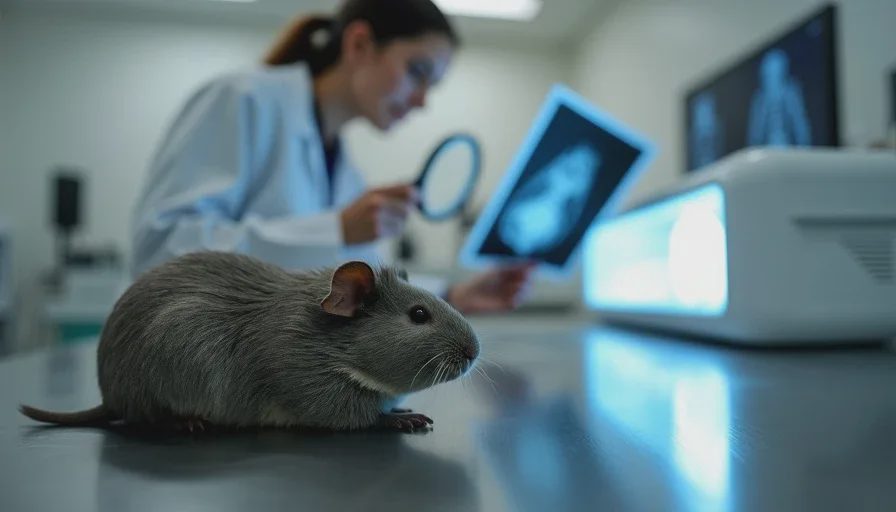
The emergency vet on duty — a wonderful colleague who will remain nameless here, because I'm still not sure she's forgiven me for waking her — did a focused exam. Peanut's gut sounds were quiet, his temperature was low-normal, and the x-rays showed gas buildup that was slowing everything down. The diagnosis was early GI stasis, the condition where a guinea pig's digestive tract simply starts to stall. Left untreated, it kills quickly. Caught early, it's treatable.
The treatment wasn't glamorous: pain relief, fluids under the skin, a medication to get the gut moving again, and instructions to hand-feed a recovery formula every few hours through the night. I did that feed, and at 3 a.m., Peanut produced a single, tiny little dropping — which, let me tell you, is the most beautiful thing I have ever seen a guinea pig do.
The $400 Lesson
The bill came to 400 in my head and in the title of this article. Exam, x-rays, medications, fluids, and the late-night emergency fee. For a small pet at an emergency clinic, that's actually a very ordinary number — small pet emergencies routinely run 800, and surgery or hospitalization can go far higher.
Here's the honest part: $400 wasn't a crisis for us. We could cover it. But watching me pay it, I realized how differently this story could have gone — and how it goes for so many families every night.
What the $400 actually bought us:
What we paid for | What it covered |
|---|---|
Emergency exam + late fee | A vet's trained eyes at the exact moment we needed them |
X-rays | Seeing the gas, confirming it wasn't a blockage |
Pain meds + gut motility drugs | The things that actually turned Peanut around |
Subcutaneous fluids | Rehydration and support while his system restarted |
Syringe-feeding formula | Keeping his gut moving through the night |
And here's the lesson that stuck: the $400 was never the point. The point was that the money existed when we needed it. The families who end up in the worst situations are rarely the ones who don't love their animals — they're the ones who have to choose between rent and the emergency bill, in a moment when waiting "until tomorrow" can cost a small pet their life.
The Preparedness Lesson
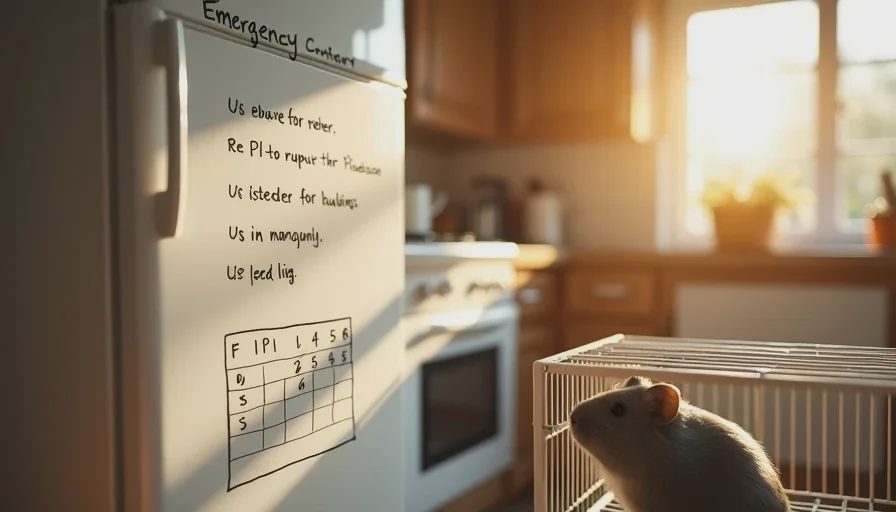
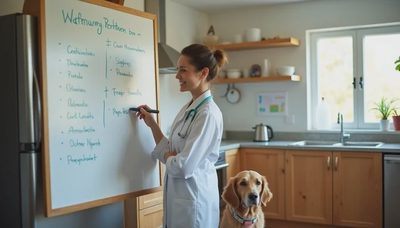
So here's what I changed after that night, and I want you to do the same before you need it. I keep a dedicated emergency fund for the animals now — it's not a huge number, but it covers an exam-and-basics night like ours, because that's the most common shape an emergency takes. I also typed out the after-hours clinic's number and taped it to the fridge, next to the whiteboard that tracks who ate, who pooped, and who's sulking. (Peanut gets a checkmark on that board every single day now, and he knows it.)
The most important change was mental. I built a tiny care-kit in my head for every animal in the house: what does "off" look like for Biscuit? For Mabel? For Peanut? Because the single most valuable thing in an emergency isn't the money or the phone number — it's knowing, in advance, what your animal's normal looks like. That's the difference between "maybe it's nothing" and "this is not right, and I'm going now."
A good start beats a late fix. I've said that about training puppies and about savings accounts, and it's truest of all in an emergency: the families who prepare for the worst night get to spend that night acting instead of panicking.
Why I'm Telling You This
I'm telling you this story not because it's dramatic — a guinea pig with gas isn't exactly a blockbuster plot — but because it's the most ordinary emergency I've ever handled, and it's exactly the one that catches people off guard. It wasn't a dramatic fall or a poisoning. It was a senior pet having a bad night, and an owner who almost waited to see if it would pass.
So let me leave you with the checklist I keep on the fridge, the one that starts with the single most important question: when to call the vet. Call if your pet hasn't eaten in twelve hours (six for small pets), hasn't produced droppings, is straining, is vomiting or having diarrhea that won't stop, is struggling to breathe, has pale gums, has been hit or fallen, or is simply "not right" and your gut says so. Trust the gut. My gut nearly let me down that night, and I'm a professional — the margin for error was that thin.
Peanut is still with us, still seven, still outranking everyone. He celebrated his survival by pooping on my kitchen floor at 6 a.m., which felt like an appropriate royal response to being saved. And every time I see his checkmark on the whiteboard, I'm grateful I didn't wait until morning. Call early, call with confidence, and let the professionals help you sort out what's an emergency and what isn't — that's literally what the emergency fee is for.


No comments yet — grab the first one.