Introducing cat to dog is not a one-day event — it's a two-to-four-week protocol that depends on patience, scent management, and controlled exposure. When the dog in question is a bouncy, uncoordinated puppy with zero feline etiquette, the process gets harder, not easier. Puppies don't read body language well. They chase moving things. They don't know that a swishing tail means "back off." I'm Willa Sutter, DVM, and in my Colorado Springs practice, I've coached hundreds of families through this exact scenario. The protocol I'm about to walk you through is the same one I used when we brought Copper — our energetic Labrador mix — home to meet Mabel, our calico cat who had been running the household for three years. It's also the same framework I recommend when clients ask me about how to introduce two cats, because the underlying principles are identical: control scent first, control sight second, control contact last.
Phase 1: Scent Swap (Days 1–3)
The first phase happens before the puppy and cat ever see each other. You're building familiarity through smell, which is the primary sense both animals use to identify safe versus threatening individuals. Set the puppy up in a single room with a door — a guest bedroom or laundry room works. The cat retains access to the rest of the house. This separation is non-negotiable.
Here's the scent swap protocol I use and recommend:
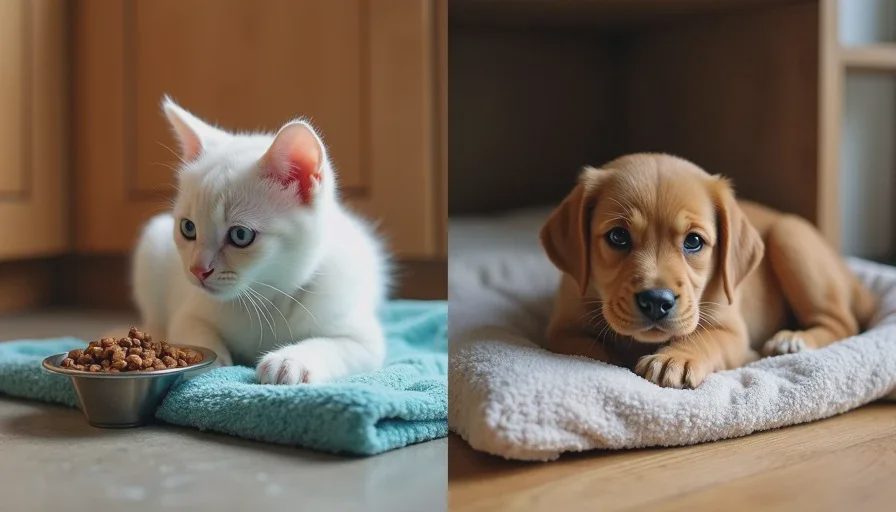
Day 1: Take a clean towel and rub it along the puppy's cheeks, flanks, and paws. Place the towel near the cat's food bowl. Do the same in reverse — rub a towel on the cat and place it near the puppy's crate.
Day 2: Move each towel closer to the other animal's resting area. If the cat hisses at the puppy-scented towel, that's normal. Leave it. Don't remove it just because there's a reaction.
Day 3: Swap bedding — put the puppy's blanket in the cat's space and vice versa. Watch for signs of calm: eating near the scented item, sleeping near it, or ignoring it entirely.
Reading the Cat's Signals
Cats communicate willingness through small behaviors that are easy to miss. Here's what I tell clients to look for:
Behavior | What It Means | Action |
|---|---|---|
Hissing or growling at scented towel | Normal initial response | Continue protocol, don't rush |
Refusing to eat near scented item | High stress — too much too fast | Move item farther from food, extend Phase 1 |
Eating calmly near scented item | Acceptance of scent | Proceed to Phase 2 |
Sleeping on or near scented item | Strong acceptance | Proceed to Phase 2 with confidence |
Avoiding the room with the scent | Fear-based avoidance | Extend isolation, consult a trainer |
Mabel hissed at Copper's towel for two full days. On day three, she slept on it. That was my green light. A good start beats a late fix, and rushing this phase is the leading reason introductions fail.
Phase 2: Visual Access Without Contact (Days 4–7)
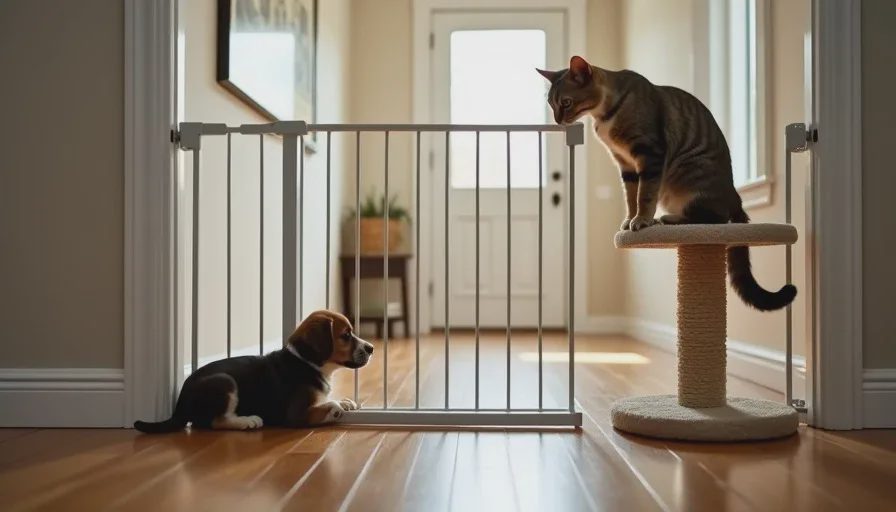
Once both animals are calm around each other's scent, you move to controlled visual access. The goal is for them to see each other without being able to reach each other. A baby gate is your primary tool here — ideally a tall one, at least 36 inches, because puppies can be surprisingly athletic.
Set up the baby gate in the doorway of the puppy's room. Open the door and let them see each other for short, structured sessions. I recommend three to five minutes per session, three times a day. Keep the puppy on a leash — not because you expect trouble, but because you need to be able to redirect instantly.
The Puppy Management Challenge
The hard part of this phase isn't the cat. It's the puppy. Puppies are wired to investigate moving objects, and a cat walking away is an invitation to chase. You need to actively manage the puppy's behavior during visual sessions:
Keep high-value treats ready — Use small pieces of chicken or cheese. The moment the puppy looks at the cat and doesn't lunge, mark it with a "yes!" and reward.
Use a leash even indoors — A lightweight 4-foot leash gives you control without being intrusive.
End sessions before they go bad — If the puppy starts whining, straining, or barking, the session is over. Close the door. Try again in a few hours. Don't wait for a failure to end the session — end on a success.
Let the cat leave when it wants — The cat must always have an escape route. If the cat feels trapped, you'll lose weeks of progress in ten seconds.
Phase 3: Supervised Contact (Days 8–14)
If Phase 2 went well — meaning both animals were calm, the puppy wasn't straining at the leash, and the cat was willing to stay in the room — you move to supervised contact. Remove the baby gate but keep the puppy on a leash. Allow them to be in the same room for 10–15 minute sessions.
This is where I see most families make a critical mistake: they let the puppy off-leash too early. A puppy that has been "good" for three days on-leash is not ready for off-leash freedom. On-leash good behavior means the puppy is responding to your management, not making independent choices. You need off-leash calm before you remove the leash.
The Progression Checklist
Use this checklist to determine when to advance each step:
Milestone | Requirement to Advance | Typical Timeline |
|---|---|---|
Scent swap → Visual access | Cat eats/sleeps near puppy scent | Days 3–5 |
Visual access → Supervised contact | Puppy ignores cat on leash for 3+ sessions | Days 6–10 |
Supervised → Off-leash (puppy) | Puppy checks in with you when cat moves | Days 10–14 |
Off-leash → Unsupervised brief | Animals ignore each other for 30+ min | Days 14–21 |
Brief unsupervised → Full access | No incidents across multiple brief sessions | Days 21–28 |
These timelines assume a typical, well-socialized puppy and a confident adult cat. If either animal has a history of anxiety or aggression, double the timeline and consult a professional. The same framework applies when you're learning how to introduce two cats — scent first, sight second, contact last — but cat-to-cat introductions often take longer because cats hold grudges in ways dogs don't.
Phase 4: Management for the Long Term
Even after successful introduction, you need permanent management structures. Cats and dogs coexist more peacefully when each has its own space and resources. Here's what I recommend every household set up:
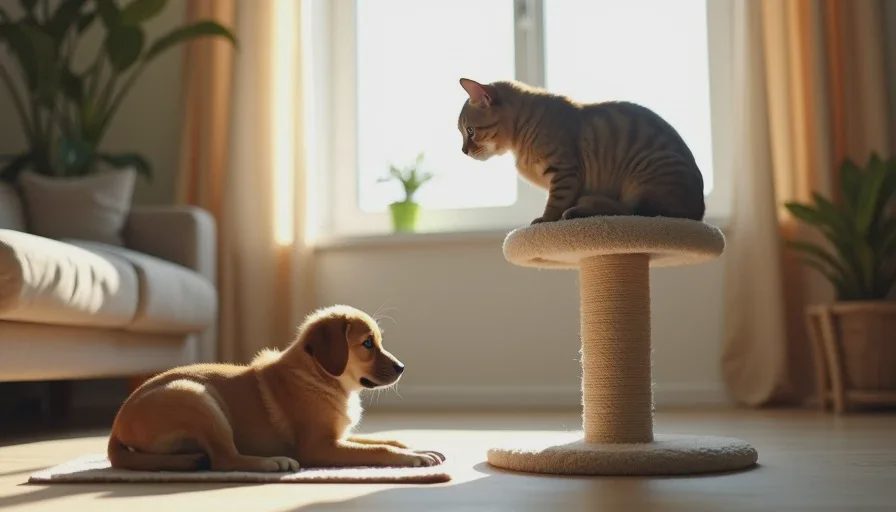
Elevated cat-only zones — Cats need vertical space the dog can't reach. A cat tree, wall shelves, or a baby-gated room with a cat-sized opening gives the cat a retreat.
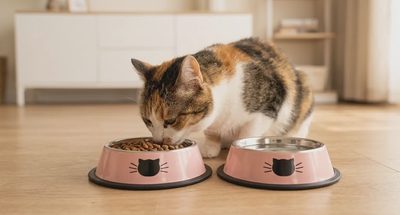
Separate feeding stations — Feed the cat where the puppy can't reach it. Dogs eating cat food causes gastrointestinal upset, and cats eating dog food leads to nutritional deficiencies over time.
Two litter boxes minimum — Place litter boxes where the puppy cannot access them. Puppies eating cat feces is gross and a health risk (transmission of parasites like Toxoplasma).
Structured puppy exercise — A tired puppy is a puppy that doesn't chase the cat. Ensure your puppy gets adequate physical and mental exercise before unsupervised time with the cat.
When to Call for Help
If at any point the cat stops eating, stops using the litter box, or starts hiding for more than 24 hours, stop the introduction and call your veterinarian. These are stress signals that indicate the process is moving too fast. Similarly, if the puppy shows resource guarding behavior around food or toys when the cat is present, consult a professional trainer before continuing. Stress in cats can lead to urinary issues, and I've seen introductions that went too fast result in $400 emergency visits for feline lower urinary tract disease — entirely preventable with patience.
The introduction process isn't glamorous. It requires weeks of door management, towel swapping, and structured sessions. But done correctly, it sets up a household where your cat and puppy can coexist peacefully — and occasionally, become genuine friends. Mabel and Copper now nap in the same room most afternoons, which I consider a victory. They're not cuddling, but nobody's sulking, and on the kitchen whiteboard, that counts as a win.


No comments yet — grab the first one.