
Multi pet household tips usually come from trainers and behaviorists, but I am going to give you the unfiltered version from inside my own house — where two dogs, two cats, and a senior guinea pig named Peanut have spent years teaching me what actually works. I am Willa Sutter, a general-practice vet in Colorado Springs, and my kitchen has a whiteboard that tracks "who ate, who pooped, who's sulking" on any given day. This is the real story of how my zoo functions, the dynamics that took me by surprise, and the lessons you can take into your own multi-pet home. A good start beats a late fix — and that applies to introducing pets as much as it does to anything else in veterinary medicine.
Meet the Crew
Every animal in this house has a distinct personality, and understanding those personalities is the foundation of every multi pet household tip I will give you. You cannot manage what you have not bothered to observe.
Biscuit — The Senior Dog Who Rules by Glare
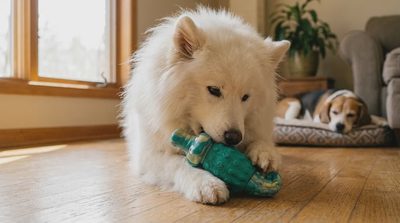
Biscuit is an 11-year-old mixed breed, roughly 45 pounds, who I adopted as a young adult from a shelter in Fort Collins during my last year of vet school. She is the dog who taught me that calm does not mean passive. Biscuit does not bark, does not lunge, does not demand attention. She simply stares at the offending party until they reconsider their life choices. When we brought Copper home as a puppy, Biscuit lay on her bed and watched him tornado around the living room for 20 minutes. He eventually collapsed at her feet. She has been in charge ever since.
Biscuit's role in the household: peacekeeper, schedule enforcer, and the one who decides when the dogs go outside. She is also the reason I started narrating pet introductions like a nature documentary — "Here we see the elder dog observing the young interloper with measured tolerance" — which drove my husband Adam crazy until he started doing it too.
Copper — The Enthusiast
Copper is a 4-year-old Australian Cattle Dog mix, 38 pounds, adopted at 8 weeks from a local rescue. He is the dog who greets every morning like it is the first morning he has ever experienced. Copper's defining trait is intensity — he does not walk, he patrols. He does not eat, he devours. He does not love, he attaches himself to your leg like a barnacle.
Copper required the most management of any animal I have brought into this house. His herding instinct meant he tried to herd the cats for the first three months. His energy level meant Adam was running him on trails twice a day. His attachment style meant we went through a separation anxiety phase that tested every crate-training principle I teach my clients. He is also the dog who bonded hardest with my daughter Ruby — they are inseparable on weekends.
Mabel and Oscar — The Cat Coalition
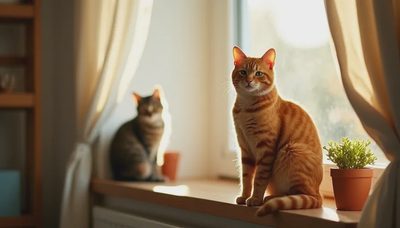
Mabel is a 9-year-old tortoiseshell with the personality that torties are famous for: opinionated, selective in her affections, and deeply committed to sitting on whatever you are currently working on. Oscar is a 7-year-old orange tabby who behaves like a golden retriever in a cat suit — friendly with everyone, zero boundaries, and a tendency to follow the dogs around the yard.
The dynamic between these two cats is a study in opposites. Mabel tolerates Oscar the way a queen tolerates a jester. Oscar does not notice the tolerance level; he just wants to be near someone. When we introduced Copper to the household, Mabel retreated to high ground for three days and then came down like nothing had happened. Oscar tried to befriend Copper on day one and got herded into a bookshelf. They worked it out.
Peanut — The Senior Guinea Pig Who Outranks Everyone
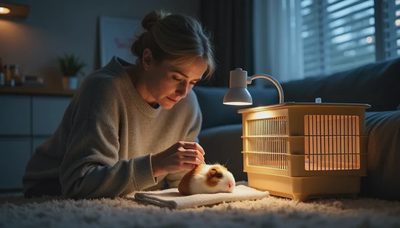
Peanut is a 6-year-old guinea pig who has lived in my son Otis's room since he was five. Peanut is the animal I reference most often when clients ask me about small pet care, because guinea pigs are wildly underestimated. Peanut has a personality, preferences, and a clear opinion about who is allowed to hold him (Otis and me) and who is not (Adam, who Peanut has decided is suspicious).
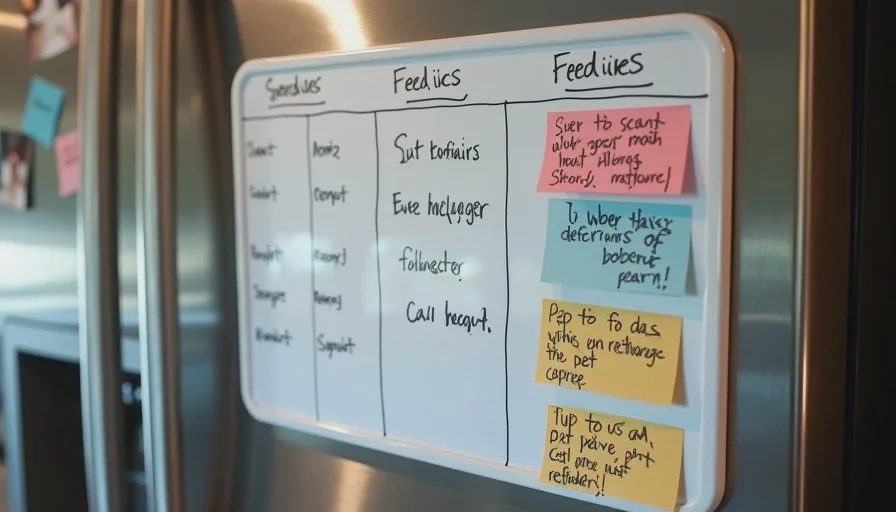
Peanut's cage is in Otis's room, which means he is separated from the dogs and cats — this is non-negotiable for safety. But Peanut's influence on the household hierarchy is outsized. When it is vegetable-prep time, all five animals converge on the kitchen because they all get a piece of whatever Pepper is getting. The whiteboard on my fridge has a column for Peanut that reads "ate: yes, pooped: extensively, sulking: no, he is thriving."
How My Zoo Actually Functions
Running a multi-pet household is less about training individual animals and more about managing systems — feeding rotations, space allocation, and attention distribution. Here is what 14 years of veterinary medicine and 11 years of living with this crew have taught me.
The Feeding System
Feeding five animals with different dietary needs is the most logistically complex part of my day. Here is the system that took me years to refine:
Animal | Food Type | Fed Where | Fed When | Why |
|---|---|---|---|---|
Biscuit | Senior joint-support kibble | Kitchen, elevated bowl | 7am / 5pm | Joint support, slow eater |
Copper | Active adult formula | Laundry room, separate | 7am / 5pm | Prevents food competition |
Mabel | Weight management wet + dry | Cat shelf, high location | 6:30am / 6pm | Keeps her lean, away from dogs |
Oscar | Same as Mabel | Cat shelf, opposite end | 6:30am / 6pm | Separate bowls, same shelf |
Peanut | Guinea pig pellets + fresh veg | Otis's room, in cage | Morning + evening veg | Fresh hay available 24/7 |
The key insight: every animal eats in a different location. This eliminates food guarding, reduces stress, and means I can actually track who ate on the whiteboard without guessing. Copper would eat everyone's food if given the chance — he is a cattle dog, and cattle dogs do not leave food unattended by choice.
The Space Map
Dogs have the main floor: Kitchen, living room, backyard access through a dog door
Cats have vertical space: A cat shelf system in the living room, plus the upstairs hallway and bedrooms
Peanut has Otis's room: Door stays closed, dogs are not allowed in without supervision
The basement is neutral territory: No one claims it, which makes it useful for separations during introductions or illness
This spatial separation is the single most important thing I did to make this household function. Animals need territory they can call their own. When I bring home a new pet — which I have done four times now — the first question is not "how do I introduce them" but "where does this animal live that is already theirs?"

Lessons I Pass Along to My Clients
Every multi pet household tip in this section comes from a mistake I made or a moment I got right by accident. I share these with my clients because textbook advice only takes you so far.
Introductions Take Longer Than You Think
When I brought Copper home, I did everything by the book — separate room, scent swapping, controlled introductions through a baby gate. It still took six weeks for Biscuit to fully accept him. The book says one to two weeks. Real life says otherwise. The timeline depends on the resident animal's age, the new animal's energy level, and how much spatial separation you can maintain. My advice: double whatever timeline you have in your head, and you will be closer to reality.
The Whiteboard Changed Everything
I started the kitchen whiteboard during a week when Mabel stopped eating and I could not remember when it started. The board now tracks daily: who ate, who pooped, who seems off. It sounds obsessive, but when you have five animals, you cannot rely on memory. That whiteboard has caught two illnesses early — Mabel's dental issue and Biscuit's recurring urinary tract infection — because the pattern was visible on paper before I noticed it in person. This is the multi pet household tip I give to every client with more than two animals: write it down.
Attention Is a Resource
Dogs and cats experience attention as a resource, just like food and space. When I spent a week focused on Oscar because he had an ear infection, Mabel started urinating on the bathmat. She was not sick — she was sending a message. I now rotate intentional one-on-one time with each animal, even if it is just five minutes. Biscuit gets a quiet grooming session. Copper gets a training drill. Mabel gets lap time while I read. Oscar gets his brush session. Peanut gets floor time in the hallway with a barrier up. No one feels invisible, and the behavioral issues that come from jealousy have nearly disappeared.

No comments yet — grab the first one.